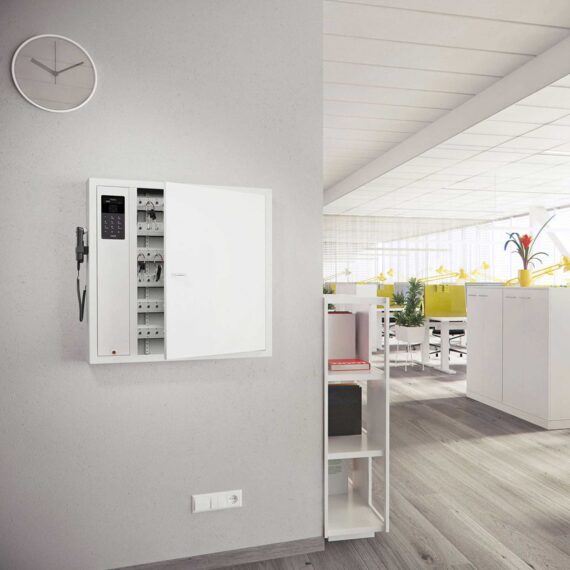

Smart Key Management System in Qatar
In today’s fast-paced and security-conscious world, the ability to manage access to physical keys efficiently is critical across various industries. Traditional key handling methods are no longer sufficient for modern businesses that demand accountability, security, and automation. This is where the Smart Key Management System comes into play.
Axle Systems, a trusted technology integrator in Qatar, offers advanced Smart Key Management System that meet the highest standards of security, automation, and traceability. Featuring global brands like Landwell, our Smart Key Management System cabinets are ideal for sectors like government, transportation, hospitality, banking, real estate, and more.
In this detailed blog post, we will explore what a Smart Key Management System is, its benefits and features, where it is used, and how Axle Systems can help organizations across Qatar implement these systems with expert support.
Table Of Contents
- 1 What is a Smart Key Management System?
- 1.1 Benefits of Smart Key Management System
- 1.1.1 1. Enhanced Security and Access Control
- 1.1.2 2. Real-Time Monitoring and Alerts
- 1.1.3 3. Complete Audit Trail and Reporting
- 1.1.4 4. Prevention of Key Loss and Misplacement
- 1.1.5 5. Improved Operational Efficiency
- 1.1.6 6. Centralized Control with Scalable Software
- 1.1.7 7. Multi-Factor Authentication for High Security
- 1.1.8 8. Customizable Permissions and Time-Based Access
- 1.1.9 9. Integration with Existing Systems
- 1.1.10 10. Cost Savings Over Time
- 1.1.11 11. Emergency Override and Fail-Safe Options
- 1.1.12 12. Better User Accountability and Discipline
- 1.2 Key Features of Smart Key Management System
- 1.2.1 1. RFID-Based Key Tagging for Identification
- 1.2.2 2. Tamper-Proof Electronic Cabinets
- 1.2.3 3. User Authentication (PIN, RFID Card, Biometric, Face Recognition)
- 1.2.4 4. LED Indicators and Key Guidance
- 1.2.5 5. Modular and Scalable Design
- 1.2.6 6. Centralized Software Dashboard
- 1.2.7 7. Time-Based Access Scheduling
- 1.2.8 8. Real-Time Alerts and Notifications
- 1.2.9 9. Complete Audit Trail and Logging
- 1.2.10 10. Remote Access and Control (LAN, Wi-Fi, Cloud)
- 1.2.11 11. Power Backup and Fail-Safe Operation
- 1.2.12 12. Multi-Language User Interface
- 1.2.13 13. Third-Party Integration
- 1.2.14 14. Touchscreen User Interface
- 1.3 Uses of Smart Key Management System in Qatar
- 1.3.1 1. Government Ministries and Public Sector Offices
- 1.3.2 2. Hotels, Resorts, and Hospitality Industry
- 1.3.3 3. Real Estate and Property Management
- 1.3.4 4. Automobile Dealerships and Car Rental Companies
- 1.3.5 5. Airports, Ports, and Transportation Hubs
- 1.3.6 6. Corporate Offices and Business Towers
- 1.3.7 7. Education Sector: Universities, Colleges, and Schools
- 1.3.8 8. Healthcare Facilities: Hospitals, Clinics, and Pharmacies
- 1.3.9 9. Banking and Financial Institutions
- 1.3.10 10. Industrial Zones and Warehousing
- 1.3.11 11. Shopping Malls and Retail Chains
- 1.3.12 12. Security Agencies and Defense Services
- 1.4 Featured Brand: Landwell Smart Key Management System
- 1.5 Axle Systems: Your Trusted Partner for Smart Key Management System in Qatar
- 1.6 Common FAQs About Smart Key Management System
- 1.7 The Future of Key Management is Here
- 1.1 Benefits of Smart Key Management System
What is a Smart Key Management System?
A Smart Key Management System is an intelligent, automated solution designed to control, track, and manage the use of physical keys within an organization. These systems typically consist of electronic cabinets with individual key compartments, RFID tracking, PIN/biometric/card authentication methods, and centralized software management.
The system ensures that only authorized users have access to specific keys and maintains a full audit trail of who took a key, when, and for what purpose. In case of non-return, alerts can be generated instantly. This kind of automation not only enhances physical security but also improves operational efficiency.
Benefits of Smart Key Management System
In any organization that relies on physical keys for access to assets, areas, vehicles, or equipment, the way those keys are managed can significantly impact security, efficiency, and accountability. A Smart Key Management System goes far beyond basic key storage—it introduces automation, security protocols, and real-time intelligence to an otherwise manual and often chaotic process.
Here’s a detailed look at the key benefits of deploying a Smart Key Management System in your organization:
1. Enhanced Security and Access Control
One of the most significant benefits of Smart Key Management System is eliminating unauthorized access to physical keys. Each key is securely stored in an electronically controlled slot or compartment. To access a key, a user must authenticate their identity—typically through a PIN code, RFID card, fingerprint, or face recognition. The system verifies access rights before releasing a key.
Example: In a corporate office building, only the facility manager can retrieve the key to the server room. Even if another staff member gains physical access to the cabinet, they cannot retrieve the key without the correct authentication and permission settings.
Benefits:
- No more master keys lying around.
- Prevents internal misuse or tampering.
- Enforces chain-of-custody for sensitive keys.
2. Real-Time Monitoring and Alerts
Smart Key Management System cabinets allow 24/7 monitoring of key access activities. Admins receive real-time notifications for events such as:
- Key not returned on time
- Unauthorized attempt to access a key
- Cabinet door left open
- Power disconnection or tampering
These alerts can be sent via SMS, email, or software notifications, allowing quick intervention.
Example: In a hospital, if the medicine storage room key isn’t returned after a shift, the system notifies the security team to investigate or lock down the area if needed.
Benefits:
- Immediate action on unusual activities
- Ensures prompt return of critical keys
- Reduces risk of theft, negligence, or loss
3. Complete Audit Trail and Reporting
Every key transaction is automatically recorded—who took it, when, for what duration, and when it was returned. This digital audit trail is invaluable for accountability, audits, and incident investigations.
Example: In a car rental business, if a vehicle is damaged and the key history shows that only one employee accessed it during that period, accountability is clear.
Benefits:
- Transparent key handling processes
- Supports internal investigations and insurance claims
- Meets compliance and regulatory requirements
4. Prevention of Key Loss and Misplacement
Misplaced keys can lead to serious disruptions, security breaches, and costly re-keying. With a smart system, keys can only be accessed by approved users and must be returned to their original slot, guided by LED indicators or visual maps. The system ensures that keys are not left unattended or taken home unintentionally.
Example: In a logistics company, a driver cannot start their shift without returning the key from the previous day. If a key is missing, the system shows the last person who accessed it, enabling quick resolution.
Benefits:
- Drastically reduces key loss incidents
- Saves costs on replacement or re-keying
- Protects high-value or sensitive assets
5. Improved Operational Efficiency
Manual key handling processes—signing logbooks, searching for keys, or calling admins—are time-consuming. Smart key systems automate the entire process, ensuring quick key issuance and return, allowing employees to focus on their core tasks.
Example: In an airport facility, maintenance staff can instantly access tool storage room keys at any hour using fingerprint authentication, without waiting for supervisors.
Benefits:
- Saves staff time and effort
- Minimizes administrative overhead
- Reduces delays in operational tasks
6. Centralized Control with Scalable Software
Modern systems like those from Landwell are equipped with powerful software that allows centralized management of multiple key cabinets across different locations. Admins can control user access, generate reports, track keys, and even block access remotely.
Example: A property management company with branches in Doha and Lusail can monitor all key activities from a single control center, using cloud-based software.
Benefits:
- Unified key management across sites
- Remote administration and analytics
- Scalable as the organization grows
7. Multi-Factor Authentication for High Security
For sensitive environments such as data centers or defense installations, Smart Key Management System supports multi-factor authentication. This could include a combination of:
- RFID card + PIN
- Fingerprint + Face ID
- RFID card + Admin approval
Example: In a bank vault scenario, access to vault room keys may require dual authorization—both the branch manager and security officer must authenticate within a limited time window.
Benefits:
- High-level security protocols
- Eliminates single-point vulnerabilities
- Supports industry-specific compliance standards
8. Customizable Permissions and Time-Based Access
Smart Key Management System allow setting user-specific rules such as:
- Who can access which keys
- On which days or times
- For how long
This granular control is especially useful in shift-based or role-based organizations.
Example: In a hotel, housekeeping staff can only access master keys between 6 AM and 3 PM. Outside this window, access is restricted automatically.
Benefits:
- Avoids unauthorized access during off-hours
- Enforces shift-based or location-based restrictions
- Reduces reliance on manual supervision
9. Integration with Existing Systems
Advanced Smart Key Management System cabinets can integrate with:
- Access control systems
- HR or attendance systems
- Security cameras or alarm systems
- Visitor management software
Example: If an employee resigns, the HR system updates the key management software to automatically revoke their key access rights.
Benefits:
- Seamless security ecosystem
- Automated user provisioning and deactivation
- Improved situational awareness
10. Cost Savings Over Time
While the upfront cost of a Smart Key Management System is higher than manual methods, the long-term ROI is substantial. It helps prevent theft, reduce key losses, eliminate downtime, and lower labor costs associated with manual tracking.
Example: A large commercial building reduces annual key replacement costs by 70% after implementing a smart system. The savings pay off the investment within the first year.
Benefits:
- Lowers total cost of ownership
- Prevents revenue loss due to operational delays
- Enhances asset protection value
11. Emergency Override and Fail-Safe Options
In emergencies like power outages or software failures, Smart Key Management System includes manual override options. These may include master admin access, backup power supplies, or mechanical keys for emergencies.
Example: During a fire drill or system malfunction, authorized personnel can still retrieve emergency exit keys via admin override.
Benefits:
- Ensures business continuity
- Meets safety and emergency preparedness standards
- Builds trust in system reliability
12. Better User Accountability and Discipline
Knowing that every key transaction is tracked, users become more responsible and disciplined in how they handle company property. This promotes a culture of accountability and care among employees.
Example: In a fleet management company, drivers become more punctual in returning keys to avoid late penalties recorded by the system.
Benefits:
- Reduces carelessness or misuse
- Promotes a security-first mindset
- Improves workplace professionalism

Key Features of Smart Key Management System
Modern Smart Key Management System are more than just locked cabinets—they are intelligent, integrated platforms that combine physical security with digital automation. These systems are designed to secure keys, streamline access, improve compliance, and provide complete visibility of key usage within your organization.
Below is a detailed look at the key features of high-quality Smart Key Management System, especially those from Landwell, a leading global brand trusted by enterprises in Qatar and around the world.
1. RFID-Based Key Tagging for Identification
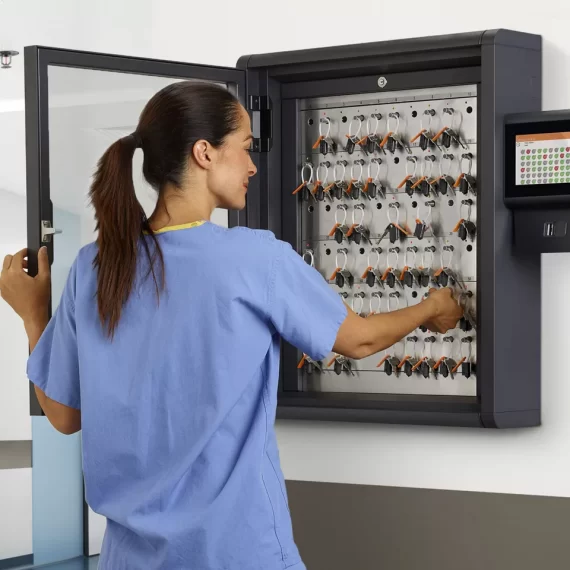
Each key in the system is uniquely tagged using RFID (Radio Frequency Identification) technology. The RFID tags are embedded within key fobs or rings that are connected to physical keys. When a key is inserted into or removed from a slot, the system identifies it instantly.
Benefits:
- Automatically identifies each key without manual input
- Eliminates errors from key swapping or mixing
- Enables precise tracking of key movement in real time
Example Use in Qatar: In an airport maintenance department, every vehicle or tool room key is RFID-tagged, so staff access is logged automatically without delays.
2. Tamper-Proof Electronic Cabinets
Smart Key Management System cabinets are built with high-security materials—metallic or polycarbonate enclosures with electronic locking compartments. These cabinets are resistant to tampering, prying, or forced entry and are often certified for industrial use.
Benefits:
- Physically secure key storage
- Ensures that only authorized users can access the cabinet
- Deters insider and outsider tampering attempts
Example Use in Qatar: A bank secures vault room keys in tamper-resistant cabinets located inside the operations room, monitored by internal security.
3. User Authentication (PIN, RFID Card, Biometric, Face Recognition)
Access to the system is controlled via multi-layered user authentication. You can configure one or more methods based on your organization’s security policies:
- PIN Codes – Simple and cost-effective
- RFID Cards – Used with staff ID cards or access badges
- Biometric Scanners – Fingerprint or palm vein readers
- Facial Recognition – Touchless and ideal for hygienic environments
Benefits:
- Prevents unauthorized access
- Supports personalized access levels
- Flexible for different industries and user preferences
Example Use in Qatar: In a logistics company, drivers use their fingerprint and RFID card combo to access fleet keys before shift changes.
4. LED Indicators and Key Guidance
Inside the Smart Key Management System, LED indicators guide users to the exact slot where a key is stored or must be returned. This intuitive visual aid prevents mistakes and reduces retrieval time.
Benefits:
- Quick and error-free key retrieval
- Prevents incorrect key returns
- Ideal for shift-based operations with high turnover
Example Use in Qatar: In a luxury hotel in West Bay, housekeeping staff can instantly locate their assigned master key using the green flashing LED indicator.
5. Modular and Scalable Design
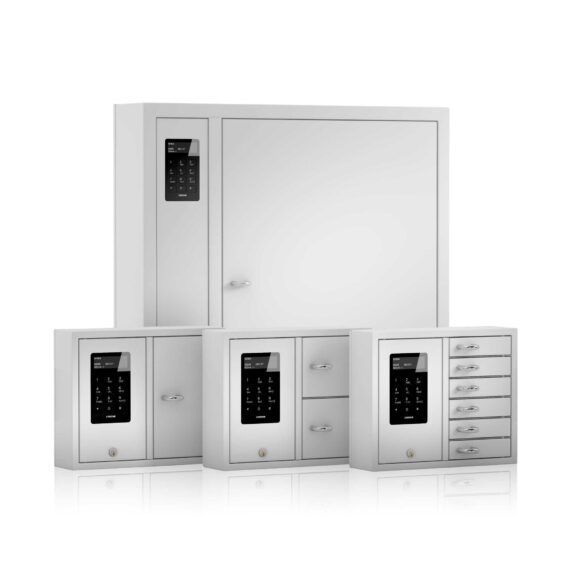
Smart Key Management System can be customized to fit the organization’s needs. Cabinets are available in various sizes and can be expanded as required. You can start with a small unit (10–20 keys) and scale up to hundreds of keys across multiple locations.
Benefits:
- Pay as you grow
- Easy to expand with additional modules or cabinets
- Supports centralized and decentralized models
Example Use in Qatar: A construction company starts with 30 keys for a single site and later expands the same system to manage keys across 4 sites in Lusail and Al Wakrah.
6. Centralized Software Dashboard
The smart key system is controlled via centralized software, either hosted locally or via the cloud. Admins can perform the following from the dashboard:
- Assign or revoke user access
- View real-time status of each key
- Generate audit reports
- Set alerts for overdue or unauthorized access
- Monitor multiple cabinets from one screen
Benefits:
- Real-time visibility and control
- Simple user management
- Centralized reporting for audits and compliance
Example Use in Qatar: A facilities manager in Msheireb Downtown Doha can monitor key access across all branches from a single software interface.
7. Time-Based Access Scheduling
Administrators can define specific access schedules for users or departments. You can limit who can access which keys, on which days, and at what time intervals. The system enforces these policies automatically.
Benefits:
- Prevents misuse during off-hours
- Supports shift-based roles and limited-time access
- Enforces compliance with operational rules
Example Use in Qatar: In a data center, only IT staff can access the server room keys during weekday business hours. Access outside this window triggers alerts.
8. Real-Time Alerts and Notifications
The system can send instant alerts via SMS, email, or the dashboard in the following scenarios:
- Key not returned on time
- Unauthorized access attempt
- Cabinet tampering or power cut
- System error or network failure
Benefits:
- Immediate response to incidents
- Ensures accountability
- Helps security teams act proactively
Example Use in Qatar: A fleet manager in the oil and gas sector is alerted when a vehicle key isn’t returned by the expected time, prompting a follow-up with the driver.
9. Complete Audit Trail and Logging
Every action in the system is recorded: user login, key withdrawal, key return, failed access attempts, and system alerts. These logs are automatically time-stamped and stored, and can be exported for compliance reviews.
Benefits:
- Detailed accountability
- Supports audits and investigations
- Helps organizations comply with ISO or government regulations
Example Use in Qatar: A hotel security supervisor generates a weekly report showing every access to emergency exit keys for compliance review.
10. Remote Access and Control (LAN, Wi-Fi, Cloud)
Smart Key Management System can be accessed remotely via a web-based portal or mobile app (depending on the solution). Connectivity options include:
- Local Area Network (LAN)
- Wi-Fi
- GSM or 4G modules
- Cloud-based software access
Benefits:
- Manage from anywhere
- Suitable for companies with multiple branches
- Real-time tracking from mobile devices
Example Use in Qatar: A real estate manager monitors key usage from the company HQ while site supervisors manage their respective locations in Al Khor and Wakra.
11. Power Backup and Fail-Safe Operation
To ensure continuous operation, Smart Key Management System are equipped with uninterruptible power supplies (UPS) or battery backups. In case of power failure, some models allow manual override with a master key or admin protocol.
Benefits:
- System remains active during outages
- Emergency key access without compromising security
- Supports critical environments like hospitals and airports
Example Use in Qatar: In a healthcare facility, Smart Key Management System continue functioning during power fluctuations using built-in battery backups.
12. Multi-Language User Interface
High-end systems like those from Landwell support multi-language user interfaces, including Arabic and English—making them ideal for deployment in Qatar where diverse workforces operate.
Benefits:
- Easy to train users in their preferred language
- Reduces errors due to language barriers
- Enhances system adoption and usability
Example Use in Qatar: A logistics company deploys bilingual touchscreens for their Arabic-speaking and South Asian staff.
13. Third-Party Integration
Smart Key Management System can be integrated with:
- Access Control Systems (Suprema, Matrix, HID)
- HR and Payroll Software (for auto-enrollment)
- Video Surveillance Systems (link key access to camera footage)
- Visitor Management Systems (for temporary key access)
Benefits:
- Streamlined security ecosystem
- Automated access assignment
- Contextual logging with other security tools
Example Use in Qatar: A financial institution integrates their key cabinet with face recognition and surveillance to verify the person accessing high-security keys.
14. Touchscreen User Interface
Most smart cabinets feature an intuitive touchscreen display, which acts as the primary control interface. The screen guides users through authentication, key selection, return process, and alerts.
Benefits:
- Simple and user-friendly operation
- Reduces training time
- Ideal for fast-paced environments
Example Use in Qatar: In a car dealership, sales staff quickly access vehicle keys through a 7” color touchscreen interface with icons and visual guides.
Uses of Smart Key Management System in Qatar
Smart Key Management System are gaining rapid adoption across Qatar, driven by the increasing need for security, accountability, and operational efficiency in managing physical keys. Whether in government offices, hospitality venues, transport hubs, or corporate headquarters, these systems provide a centralized, secure, and intelligent way to control key access.
Let’s explore how different industries and sectors in Qatar are leveraging Smart Key Management Systems, and how Axle Systems is helping organizations meet their unique needs.
1. Government Ministries and Public Sector Offices
In Qatar’s public sector, the Smart Key Management System ensures secure access to restricted areas, such as record rooms, archives, security zones, and executive offices.
Government entities like MOI (Ministry of Interior), Ministry of Education, Ministry of Transport, and various municipality buildings use smart key cabinets to enforce access policies and maintain a complete log of key usage.
Use Case Example:
In a municipal planning office, keys to storage units, planning archives, and equipment lockers are stored in a smart cabinet. Only authorized personnel from designated departments can access specific keys during working hours.
Benefits:
- Ensures accountability and transparency
- Aligns with Qatar’s national security standards
- Ideal for use in highly regulated environments
2. Hotels, Resorts, and Hospitality Industry
The hospitality sector in Qatar is booming, especially with luxury hotels in areas like West Bay, Lusail, Pearl Qatar, and Al Wakrah. These properties require smart solutions to manage access to guest room master keys, housekeeping areas, staff lockers, and technical maintenance rooms.
Use Case Example:
At a 5-star hotel in Lusail, housekeeping staff must authenticate via fingerprint before retrieving their floor-specific master keys. The system tracks who accessed which key and when it was returned.
Benefits:
- Prevents misuse of master keys
- Helps track staff accountability
- Enhances guest safety and service reliability
3. Real Estate and Property Management
With the rapid expansion of residential and commercial projects across The Pearl, Msheireb Downtown, Al Sadd, and Barwa City, managing access to numerous units and facilities is a major challenge. Smart Key Management System enables real-time tracking of key usage by agents, contractors, security staff, and tenants.
Use Case Example:
In a large real estate management company in Doha, the facility team uses a smart cabinet to issue unit keys to contractors for maintenance. If a key is not returned within a set timeframe, the system sends alerts to the property manager.
Benefits:
- Manages keys across hundreds of properties
- Enables time-limited contractor access
- Centralizes control for multiple buildings
4. Automobile Dealerships and Car Rental Companies
Car dealerships and rental agencies in Qatar face a critical need to secure vehicle keys and streamline fleet operations. Smart key systems help manage access to test-drive keys, service bay keys, and customer vehicle keys.
Use Case Example:
At a luxury car dealership in Salwa Road, each test drive key is stored in a smart cabinet. Sales staff access keys using RFID cards. The system logs every transaction, helping managers track vehicle availability and test drive history.
Benefits:
- Prevents vehicle misuse
- Automates test drive key check-in/out
- Provides complete audit trail of key access
5. Airports, Ports, and Transportation Hubs
Doha’s Hamad International Airport (HIA) and commercial ports like Hamad Port require high-security key control for access to restricted zones such as tarmac areas, control rooms, baggage handling, and maintenance zones. These are critical infrastructure locations that must follow strict security protocols.
Use Case Example:
At HIA, airport operations staff use a biometric-enabled smart cabinet to retrieve keys to runway access gates and fuel storage areas. Unauthorized attempts are blocked and logged.
Benefits:
- Supports aviation and transport security standards
- Enables 24/7 secure access for rotating shifts
- Prevents access to restricted areas by unauthorized staff
6. Corporate Offices and Business Towers
In the corporate sector, Smart Key Management System is used to secure executive offices, document storage rooms, IT server rooms, and facility access keys. This is particularly useful in multi-tenant towers and enterprise buildings in West Bay, Lusail, and Energy City.
Use Case Example:
A multinational company in Tornado Tower uses a Landwell smart cabinet to manage access to boardroom keys and HR archives. Only HR staff and senior executives are allowed access through PIN and fingerprint combination.
Benefits:
- Protects sensitive business information
- Enhances corporate security governance
- Reduces dependency on facility managers
7. Education Sector: Universities, Colleges, and Schools
Educational institutions such as Qatar University, HBKU, and international schools rely on smart key cabinets to control access to labs, classrooms, libraries, and equipment storage rooms.
Use Case Example:
In a university lab building, students are granted access to lab keys only during their lab hours via fingerprint verification. The system locks them out after class hours.
Benefits:
- Supports lab and equipment safety
- Prevents unauthorized entry after hours
- Reduces administrative burden on faculty
8. Healthcare Facilities: Hospitals, Clinics, and Pharmacies
Hospitals in Qatar, like Sidra Medicine, Hamad General Hospital, and Aspetar, must secure access to pharmaceutical rooms, operating theatres, and restricted patient record rooms.
Use Case Example:
A private clinic in Doha stores all medicine cabinet and emergency room keys in a smart key cabinet. Access is granted only to authorized doctors and nurses, with time-based permissions.
Benefits:
- Ensures secure access to critical medical areas
- Provides traceability for medical compliance
- Improves patient safety and data protection
9. Banking and Financial Institutions
Banks in Qatar need robust systems to control access to vaults, safe deposit rooms, ATMs, and internal branches. Smart key management ensures traceable, permission-based key handling aligned with financial regulations.
Use Case Example:
A leading bank in Qatar deploys a smart key system at each branch to manage access to ATM maintenance and cash transfer room keys. All activities are monitored centrally from the HQ.
Benefits:
- Full accountability for key movement
- Compliance with financial security regulations
- Prevents unauthorized access to vaults or safes
10. Industrial Zones and Warehousing
Industrial zones such as Ras Laffan, Mesaieed, and the Logistics Parks often require key control for forklifts, gates, machine rooms, and hazardous storage. Smart key systems enhance safety and operational tracking.
Use Case Example:
A logistics warehouse in Umm Salal uses a smart cabinet to manage gate keys, forklift keys, and dock access. If a forklift key isn’t returned after a shift, an automated alert is sent to the supervisor.
Benefits:
- Improves safety compliance
- Prevents equipment misuse or theft
- Reduces manual log maintenance
11. Shopping Malls and Retail Chains
In malls like Villaggio, Doha Festival City, and Mall of Qatar, retailers and facility teams manage keys for kiosks, store rooms, equipment panels, and parking access gates.
Use Case Example:
A mall’s operations team uses a Smart Key Management System to issue cleaning staff the keys to electrical rooms and back offices. The system restricts access to non-operating hours and logs all activities.
Benefits:
- Streamlines facility management operations
- Protects restricted technical areas
- Tracks key use among part-time or contract staff
12. Security Agencies and Defense Services
Security firms, defense contractors, and private guards in Qatar use Smart Key Management System to manage armory keys, patrol vehicles, control room access, and equipment lockers.
Use Case Example:
A private security agency in Doha uses Landwell cabinets to assign firearms storage keys only to on-duty guards, with dual authentication (RFID + fingerprint) required.
Benefits:
- Enhances operational readiness
- Prevents unauthorized access to weapons
- Ensures full traceability of sensitive key movements
Featured Brand: Landwell Smart Key Management System
Axle Systems is proud to partner with Landwell, a globally recognized leader in intelligent Smart Key Management System. Landwell systems are renowned for their robust construction, user-friendly interfaces, and advanced security features, making them an ideal choice for a wide range of applications.
Landwell SKMS Highlights:
- Android Touchscreen Interface: Many Landwell models feature large, bright Android touchscreens, providing an intuitive and easy-to-use experience for users.
- Secure RFID Key Tags: Keys are attached to tamper-proof RFID tags that are maintenance-free and uniquely identifiable, ensuring reliable tracking.
- Multi-Factor Authentication: Supports various authentication methods including PIN, proximity card, and biometric (fingerprint, face ID) options for flexible and enhanced security.
- Individual Locking Key Slots: Keys are individually locked within the cabinet, only releasing to authorized users, providing granular control and maximum security.
- Real-time Visibility and Audit Trails: Provides instant reports on key status (who has which key, when, and why) and comprehensive audit trails for full accountability.
- Remote Management Capabilities: Through their web-based management software (like Landwell Web), administrators can gain insights, configure settings, and manage keys remotely from anywhere.
- Alerts and Notifications: Automated alerts for overdue keys or abnormal events ensure timely intervention.
- Scalable Solutions: Landwell offers a range of cabinet sizes and configurations (e.g., K26 for up to 26 keys, larger systems for up to 200 keys or more) to suit varying capacities and organizational needs.
- Integration Potential: Designed with an eye towards integration with other security and management systems, enhancing overall operational control.
- Robust Construction: Made from cold-rolled steel, ensuring durability and physical security.
Landwell’s commitment to innovation and security aligns perfectly with Axle Systems’ mission to deliver the best possible solutions to our clients in Qatar.
Axle Systems: Your Trusted Partner for Smart Key Management System in Qatar
At Axle Systems, we are more than just a supplier; we are your dedicated partner in enhancing your organization’s security and efficiency. Established in 2012, Axle Systems has grown to become an industry-leading system integrator in Qatar, specializing in a wide array of ELV (Extra Low Voltage) systems, including Electronic Article Surveillance (EAS), Queue Management Systems, Audio Visual Systems, CCTV, Parking Management Solutions, IT Solutions, and of course, cutting-edge Smart Key Management System.
Our team of experienced professionals understands the unique security challenges faced by businesses in Qatar. We don’t just sell products; we provide comprehensive solutions tailored to your specific requirements. From initial consultation and system design to seamless installation, configuration, and ongoing maintenance, Axle Systems ensures a smooth and successful implementation of your Smart Key Management System.
We are committed to delivering:
- Expert Consultation: Our specialists will work closely with you to assess your needs and recommend the optimal Smart Key Management System solution for your business.
- Quality Products: We partner with globally renowned brands like Landwell, ensuring you receive the highest quality, most reliable, and technologically advanced systems available.
- Professional Installation: Our certified technicians ensure that your system is installed efficiently, correctly, and with minimal disruption to your operations.
- Comprehensive Support: We provide ongoing technical support and maintenance services to ensure your system continues to operate flawlessly for years to come.
- Local Presence: Being based in Doha, Qatar, we offer prompt and accessible service and support to our valued clients across the country.
Contact Axle Systems Today:
Ready to revolutionize your Smart Key Management System and elevate your security posture? Get in touch with Axle Systems, your reliable Smart Key Management System supplier in Qatar.
Axle Systems Contact Details:
- Phone: +974 44682391, +974 77443731
- Website: www.axlesys.com
- Email: info@axlesys.com
- Address: P.O. Box 200081, Al Khalidiya Street, Najma, Doha, Qatar
Common FAQs About Smart Key Management System
To further clarify any queries you might have, here are some frequently asked questions about Smart Key Management System:
Q1: How secure are these systems against hacking or tampering?
A1: Smart Key Management System are designed with multiple layers of security. Physically, the cabinets are constructed from robust, tamper-resistant materials. Electronically, they employ encryption for data communication and secure authentication methods like biometrics. Most reputable systems have built-in alerts for any signs of tampering or unauthorized access attempts. While no system is 100% impervious, an SKMS drastically reduces security vulnerabilities compared to traditional methods.
Q2: What happens if there’s a power outage?
A2: Most professional Smart Key Management System come equipped with battery backup systems, allowing them to continue operating normally for a specified period (typically several hours to a day) in the event of a power failure. This ensures that key access and tracking remain uninterrupted. Some systems might have manual override options for extreme emergencies, which are securely controlled.
Q3: Can these systems be integrated with our existing access control or HR systems?
A3: Absolutely. One of the key advantages of advanced SKMS is their ability to integrate with other security and management platforms. Integration with access control systems allows for synchronized user databases and permissions, while integration with HR systems can automate user onboarding and offboarding for key access. This streamlines administration and enhances overall security.
Q4: Is it difficult to set up and manage a Smart Key Management System?
A4: Modern SKMS are designed for user-friendliness. While initial setup involves configuring users, permissions, and associating keys, the intuitive software interfaces (often web-based) make the process straightforward. Axle Systems provides professional installation and training to ensure your team can effectively manage the system from day one. Daily operation is highly automated, minimizing ongoing management effort.
Q5: What kind of maintenance do these systems require?
A5: Smart Key Management System are generally low-maintenance. Regular checks typically include ensuring the software is up-to-date, checking battery backups (if applicable), and keeping the system clean. The smart key fobs are usually passive RFID and maintenance-free. Axle Systems offers comprehensive maintenance contracts to ensure optimal performance and longevity of your investment.
Q6: What if a key fob is damaged or lost?
A6: The smart key fobs are designed to be durable. However, if a fob is damaged or lost, the system typically allows for easy deactivation of that specific fob and replacement with a new one. The system’s audit trail will record when the key was last seen and by whom, aiding in recovery or replacement procedures.
Q7: Can I remotely manage key access for staff or contractors?
A7: Yes, many advanced Smart Key Management System offer remote management capabilities through web-based platforms or dedicated mobile applications. This allows administrators to grant or revoke access, monitor key status, and view audit reports from any location with an internet connection, providing immense flexibility and control.
Q8: How many keys can a typical system manage?
A8: The capacity varies significantly depending on the model and configuration. Smaller units might manage 5-20 keys, while larger, modular systems can handle hundreds or even thousands of keys across multiple networked cabinets. Brands like Landwell offer scalable solutions to meet diverse organizational needs.
Q9: What is the return on investment (ROI) for a Smart Key Management System?
A9: The ROI for an SKMS is realized through multiple avenues, including:
- Reduced Costs: Savings from preventing lost/stolen keys (rekeying, asset replacement), lower administrative overhead, and potential insurance benefits.
- Increased Efficiency: Reduced downtime, faster access to resources, and optimized staff productivity.
Q10: Are these systems suitable for small businesses or primarily for large enterprises?
A10: Smart Key Management System are scalable and beneficial for businesses of all sizes. While large enterprises with complex Smart Key Management System needs see immediate, significant advantages, even small businesses with a limited number of critical keys (e.g., for a sensitive storage room, vehicle fleet, or specialized equipment) can greatly benefit from the enhanced security, accountability, and efficiency that an SKMS provides.
The Future of Key Management is Here
The days of cumbersome, insecure, and inefficient manual key management are rapidly becoming a relic of the past. Smart Key Management System represents a pivotal advancement in organizational security and operational efficiency. By embracing this technology, businesses can mitigate significant risks, foster a culture of accountability, and unlock new levels of productivity.
Axle Systems, as your dedicated partner in Qatar, is at the forefront of this technological revolution. We are committed to providing you with world-class Smart Key Management System, expert advice, and unparalleled support to ensure your assets are protected, your operations are streamlined, and your peace of mind is guaranteed.
Don’t let outdated Smart Key Management System practices be your organization’s weakest link. Contact Axle Systems today to discover how a Smart Key Management System can transform your security landscape and empower your business for the future. Unlock smarter security with Axle Systems.