

Door Access System in Qatar
A Door Access System (also called access control system) is an integrated set of hardware and software that controls, monitors and logs who can enter and exit physical spaces. At its core, it grants or denies access to doors, gates and turnstiles based on predefined credentials and rules. Modern systems provide centralized management, audit trails, real-time alerts and seamless integration with other security and building systems (CCTV, alarms, HR databases, building management, etc.).
Unlike traditional lock-and-key approaches, access control systems make access rights programmable, time-bound, and revocable — which improves overall security and operational flexibility.
Key Components of a Door Access System
A Door Access System is made up of several interrelated components that work together to control, monitor, and log access to your premises. Understanding each component helps in designing, implementing, and maintaining a system that is secure, reliable, and tailored to your operational needs.
1. Access Controller / Control Panel
The access controller is the brain of the system. It makes real-time decisions on whether to grant or deny access based on pre-programmed rules and credentials. The controller communicates with readers, locks, and management software.
Key points:
- Handles authentication and access decision-making.
- Logs every entry and exit event for auditing purposes.
- Can be standalone (managing one door) or networked (managing multiple doors across locations).
- May support offline operation if network connectivity is lost.
Example: A networked controller in a corporate office can manage 50 doors across multiple floors, with real-time monitoring and remote access rights management.
2. Access Readers
Readers are devices installed at doors to identify users. They detect credentials such as cards, fobs, mobile phones, or biometrics.
Types of readers:
- Card & RFID Readers: Common for office and commercial applications. Can support proximity cards, MIFARE, iCLASS or HID formats.
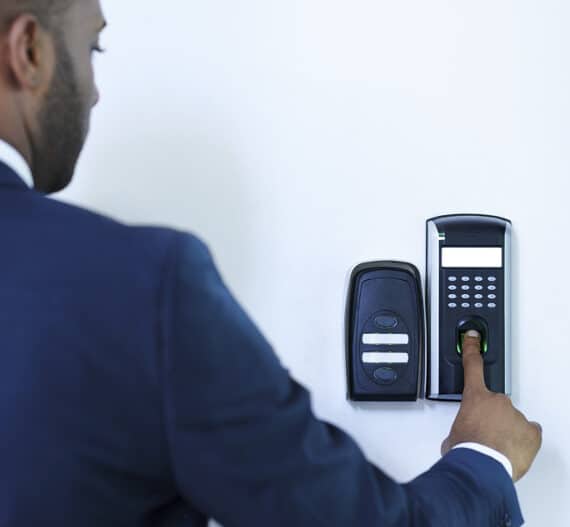
- Biometric Readers: Fingerprint scanners, facial recognition, iris scanning. Ideal for high-security areas since credentials are non-transferable.
- PIN/Keypad Readers: Users enter a code to gain access. Can be used as a standalone or with cards for multi-factor authentication.
- Mobile Credential Readers: Smartphones act as credentials via NFC or BLE, reducing the need for physical cards.
Example: A hospital may use fingerprint readers for controlled areas like pharmacies and card readers for general staff entrances.
3. Credentials
Credentials are what users present to the reader to verify identity. They come in various forms:
- Physical cards or fobs: Contactless or magnetic stripe cards, often issued to employees or residents.
- Biometric templates: Fingerprints, facial templates, or iris scans.
- Mobile credentials: Digital credentials stored in apps on smartphones.
Key considerations:
- Credentials must be unique, secure, and easily revocable.
- They should support multi-factor authentication if higher security is needed.
Example: A multi-story office might issue employees both an RFID card and a fingerprint template for secure zones.
4. Electronic Locks & Strikes
These devices physically secure doors and can be controlled electronically:
- Electromagnetic locks (Maglocks): Door remains locked until the system sends a release signal. Typically fail-safe.
- Electric strikes: Replaces the strike plate in the door frame; can be fail-safe or fail-secure depending on requirements.
- Smart locks: Integrate with wireless networks or Bluetooth for keyless entry.
- Deadbolts with electric actuation: Used in high-security environments.
Key considerations:
- Choose locks based on door type, safety requirements, and local fire codes.
- Fail-safe locks unlock during power loss; fail-secure locks stay locked.
Example: A server room may use fail-secure electric strikes to ensure the door remains locked even during power outages.
5. Request-to-Exit (REX) Devices
These sensors or buttons allow safe egress from secured areas:
- Push-to-exit buttons: Simple, reliable, and commonly installed inside the door.
- Motion sensors: Detect users approaching the exit to automatically unlock the door.
- Break-glass units: Emergency egress in compliance with safety regulations.
Key point: REX devices are critical for emergency situations to ensure occupants can exit without obstruction.
6. Cabling & Power Infrastructure
A reliable Door Access System requires proper power and connectivity:
- Network cabling: Ethernet (Cat5e/Cat6) connects controllers, readers, and management software.
- Power supply: Dedicated power sources, often with PoE (Power over Ethernet) for simplicity.
- Battery backup / UPS: Ensures doors remain operational during power outages.
Example: A corporate office may use PoE for all networked readers while installing UPS for critical server room doors.
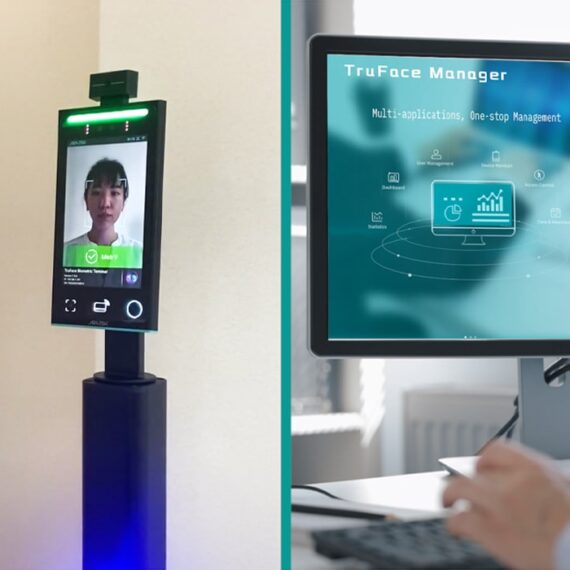
7. Management Software
The software provides centralized control of the Door Access System:
- Adds or removes users, issues credentials, and defines access schedules.
- Monitors live door status and generates audit reports.
- Provides integration with other systems like CCTV, alarm, HR, and building management.
- Can be on-premises, cloud-based, or hybrid depending on business needs.
Example: A cloud-based software platform allows facility managers to remotely manage access rights for multiple office branches from a single dashboard.
8. Auxiliary Components & Integrations
These enhance security and system efficiency:
- CCTV Integration: Automatically links video footage with access events.
- Visitor Management Systems: Temporary credentials for guests or contractors.
- Alarm Systems: Trigger alerts for forced entries or tampering.
- Elevator Control Integration: Restricts floor access based on user credentials.
Example: In a mixed-use commercial building, the Door Access System integrates with CCTV and elevators to ensure employees can only access their designated floors.
9. Monitoring & Audit Tools
- Provides real-time monitoring of all doors, alarms, and failed access attempts.
- Audit logs track access activity for security, compliance, and investigation purposes.
- Supports alert notifications via SMS, email, or push notifications.
Example: A financial institution can review failed entry attempts and immediately investigate potential security threats.
10. Redundancy & Failover Components
For mission-critical areas:
- Backup controllers: Ensure continuous operation if the main controller fails.
- Redundant network paths: Prevent system downtime due to single point of failure.
- Battery backups: Keep locks and readers operational during power outages.
Example: Data centers often use dual controllers and redundant power supplies to maintain uninterrupted access control.
Types of Door Access System
Door Access System come in various types, designed to meet different security requirements, budgets, and operational needs. Understanding the differences between these types helps businesses choose the right solution for their premises. Below is an expanded overview:
1. Standalone / Single-Door Systems
Description:
Standalone systems are designed to control one or a few doors without requiring a network connection. These systems are simple, cost-effective, and ideal for small offices, retail shops, or residential buildings.
Features:
- Local storage of credentials on the device.
- Simple user interface for adding or removing users.
- Often supports basic authentication methods like PIN, card, or key fob.
- Limited reporting and audit capabilities.
Advantages:
- Affordable and easy to install.
- Minimal maintenance and training required.
- No dependency on a network, making it more resilient to outages.
2. Networked Door Access System
Description:
Networked systems are designed for multiple doors and buildings. They connect controllers and readers over a TCP/IP network, enabling central management of access rights, audit logs, and real-time monitoring.
Features:
- Centralized management software for multiple doors and sites.
- Real-time monitoring and alerts for unusual activity.
- Integration with CCTV, alarms, visitor management, and building management systems.
- Scalable for offices, malls, and industrial facilities.
Advantages:
- Centralized control reduces administrative overhead.
- Easier to enforce company-wide policies and schedules.
- Suitable for growing organizations with multiple entry points.
3. Cloud-Based Door Access System
Description:
Cloud-based systems store and manage access control data on remote servers rather than local servers. These systems are ideal for organizations that require remote management or have multiple locations.
Features:
- Remote administration via web or mobile applications.
- Automatic software updates and backups.
- Real-time alerts and notifications to administrators.
- Simplified user onboarding and offboarding.
Advantages:
- Reduces the need for on-site IT infrastructure.
- Quick deployment with minimal hardware dependency.
- Flexible pricing with subscription-based models.
- Easily scalable to multiple sites or doors.
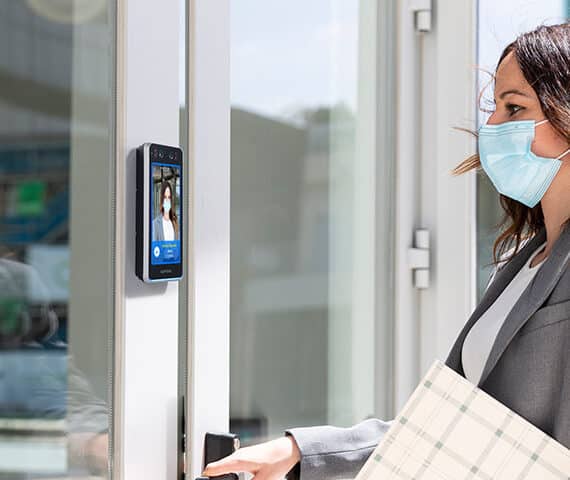
4. Biometric Door Access System
Description:
Biometric systems identify individuals based on unique biological traits, such as fingerprints, facial recognition, iris scans, or voice patterns. These systems are often used in high-security areas where non-transferable credentials are essential.
Features:
- High security with non-transferable credentials.
- Fast and contactless identification for efficiency.
- Can be combined with cards or PIN codes for multi-factor authentication.
- Audit trails linked to individual users.
Advantages:
- Eliminates the risk of lost or stolen cards/fobs.
- Difficult to duplicate or bypass.
- Enhances compliance in regulated industries.
5. Mobile Credential Systems
Description:
Mobile credential systems allow users to use their smartphones as access credentials via Bluetooth Low Energy (BLE) or Near Field Communication (NFC). These systems are becoming increasingly popular due to convenience and lower operational costs.
Features:
- Credentials stored securely in a mobile app.
- Remote provisioning and instant revocation of credentials.
- Can support multi-factor authentication with PIN or biometrics.
- Real-time access logs and notifications.
Advantages:
- Reduces cost and environmental impact of physical cards.
- Convenient for users who always carry smartphones.
- Enhanced security with encrypted digital credentials.
- Easy for visitors or contractors, as temporary mobile credentials can be issued.
6. Hybrid Door Access System
Description:
Hybrid systems combine multiple types of credentials and authentication methods for flexibility and layered security. They are ideal for organizations with diverse security needs and user groups.
Features:
- Supports cards, mobile credentials, biometrics, and PINs simultaneously.
- Configurable access policies based on role, time, or location.
- Integration with other security systems for comprehensive protection.
Advantages:
- Provides flexibility for different user types (employees, contractors, visitors).
- Enhances security by requiring multi-factor authentication for sensitive areas.
- Scalable and adaptable as organizational needs evolve.
7. Wireless / Smart Lock Systems
Description:
Wireless Door Access System or smart locks use wireless communication (Wi-Fi, Bluetooth, or Zigbee) to manage doors without the need for extensive cabling. These are ideal for retrofitting existing buildings.
Features:
- No need for complex wiring.
- Controlled via mobile apps or cloud-based platforms.
- Can be battery-powered, making installation quick and cost-effective.
- Supports audit logging and remote management.
Advantages:
- Easy to install in older buildings or areas where wiring is difficult.
- Flexible for temporary or dynamic spaces.
- Reduces installation and maintenance costs.
Benefits of a Door Access System
A Door Access System does far more than just open or close doors. Modern access control solutions provide a combination of security, operational efficiency, regulatory compliance, and user convenience. Here’s a detailed breakdown of the key benefits:
1. Enhanced Security: Door Access System
Why it matters: Traditional locks and keys are vulnerable — keys can be lost, stolen, or duplicated. Door Access System replace physical keys with programmable credentials that can be easily issued, modified, or revoked.
Features contributing to security:
- Multi-factor authentication (card + PIN, biometric + card).
- Anti-pass back rules to prevent credential sharing.
- Real-time monitoring and alerts for unauthorized attempts.
2. Auditability and Accountability: Door Access System
Why it matters: In modern businesses, knowing who accessed a particular area and when is critical for compliance, safety, and internal accountability.
How it works:
- Logs every entry and exit event.
- Provides time-stamped records of all access attempts.
- Supports detailed reporting for investigations, audits, and regulatory compliance.
3. Operational Efficiency: Door Access System
Why it matters: Managing physical keys is cumbersome, time-consuming, and prone to errors. Door Access System streamline operations by automating access control and credential management.
Key benefits:
- Quickly issue, suspend, or revoke credentials.
- Automate access schedules based on shifts or roles.
- Reduce administrative overhead associated with lock changes.
4. Scalability and Flexibility: Door Access System
Why it matters: Organizations grow, restructure, or move locations. An Door Access System must be able to scale alongside the business.
Scalability features:
- Networked or cloud-based systems can handle hundreds of doors across multiple sites.
- Hybrid systems allow multiple credential types.
- New doors or sites can be added without replacing the entire system.
5. Convenient and Customizable Access: Door Access System
Why it matters: A system must balance security with convenience. Employees, visitors, and contractors should be able to move through premises efficiently.
Convenience features:
- Time-based access control for different shifts.
- Temporary credentials for visitors or contractors.
- Mobile credentials that eliminate the need for cards.
6. Integration with Other Security Systems: Door Access System
Why it matters: Security is most effective when systems work together. Door Access System can integrate seamlessly with CCTV, alarms, fire safety, and visitor management solutions.
Integration advantages:
- Automatic video recording triggered by access events.
- Coordinated lockdown in case of emergencies.
- Streamlined visitor tracking alongside employee access.
7. Cost Savings over Time: Door Access System
Why it matters: While initial investment may seem high, the Door Access System reduces long-term costs.
Ways it saves money:
- Minimizes lock replacement costs after employee departures.
- Reduces losses from theft or unauthorized access.
- Automates administrative tasks, freeing staff time.
- Reduces the need for security personnel in monitored areas.
8. Compliance and Regulatory Support: Door Access System
Why it matters: Certain industries require strict access control for safety, confidentiality, or legal compliance.
Compliance benefits:
- Generates audit-ready reports.
- Enforces access policies aligned with industry regulations.
- Helps in achieving certifications for data protection, health, and safety standards.
9. Business Continuity and Emergency Preparedness: Door Access System
Why it matters: The Door Access System can maintain operational continuity during emergencies.
Emergency features:
- Fail-safe or fail-secure locks depending on safety requirements.
- Scheduled lockdowns or emergency release options.
- Offline operation for network disruptions.
10. Data-Driven Decision Making: Door Access System
Why it matters: Modern access control systems provide rich analytics that can improve operational decisions.
Analytical benefits:
- Track high-traffic areas to optimize security staffing.
- Identify patterns for energy management (e.g., lighting or HVAC triggered by occupancy).
- Forecast access needs for scheduling and resource allocation.
Common use cases & applications
Door Access System are used across nearly every sector. Examples:
- Corporate offices
- Secure perimeter doors, server rooms, meeting rooms and executive suites.
- Integration with HR for automated onboarding/offboarding.
- Residential buildings & gated communities
- Secure lobby access, gyms, pool areas, parking entrances, and service rooms.
- Visitor management and parcel room access.
- Government & public sector
- Secure controlled areas, classified rooms, and access for contractors with audits for compliance.
- Healthcare & hospitals
- Restrict access to pharmacies, operating theatres, patient records rooms, and isolation areas; maintain traceability.
- Education (schools & universities)
- Control labs, dormitories, libraries, and administrative offices; support emergency lockdown procedures.
- Hotels & hospitality
- Guest room access, staff-only areas, back-of-house logistics with integration into PMS for room assignment.
- Data centers & server rooms
- Multi-factor and biometric authentication for cages and racks; combined with surveillance for regulatory and contractual SLAs.
- Retail & shopping malls
- Secure stockrooms, staff areas and cash handling rooms; control deliveries and contractor access.
- Industrial & manufacturing
- Restrict hazardous areas, control access to machinery, and log entry for safety audits.
- Airports & transportation hubs
- Tiered access for secure zones, staff gates, and integration with identity checks.
Why Choose Axle Systems as Your Door Access System Supplier in Qatar?
Selecting the right supplier for a Door Access System is as critical as selecting the right system itself. A reliable supplier ensures that the solution is designed, deployed, and maintained to meet your security needs, operational requirements, and regulatory compliance. Axle Systems has established itself as a leading provider of Door Access System in Qatar, offering end-to-end solutions tailored for businesses, residential projects, hospitality, healthcare, government, and industrial sectors.
1. Local Expertise with Global Standards
Axle Systems combines local knowledge of Qatar’s regulatory environment with access to global best-in-class access control technologies. Our team understands local fire codes, building regulations, and security compliance requirements, ensuring that your system is not only effective but fully compliant.
Example: For healthcare facilities, we ensure biometric access points and data storage comply with Qatar’s health privacy regulations, protecting sensitive patient areas while maintaining audit-ready records.
2. End-to-End Solutions
From consultation and site survey to supply, installation, and commissioning, Axle Systems delivers a full spectrum of services. We do not just sell products; we provide complete solutions tailored to your unique needs.
Our services include:
- Initial assessment of doors, users, and security requirements.
- Designing a scalable access control solution that fits your budget and infrastructure.
- Installation of hardware, configuration of software, and integration with other systems (CCTV, fire alarms, HR, visitor management).
- Comprehensive testing to ensure all doors operate seamlessly.
3. Vendor-Neutral Approach
Unlike suppliers who push a single brand or system, Axle Systems offers vendor-neutral solutions, providing the right products based on your needs rather than selling a specific brand. We work with leading global manufacturers, ensuring you get high-quality, reliable equipment.
Example: For a multi-location corporate client, we deployed a hybrid system combining MIFARE card readers for general areas and biometric readers for high-security zones, integrating both seamlessly under one management platform.
4. Custom Integration Capabilities
Modern security is multi-layered. Axle Systems excels in integrating access control systems with other security and operational systems, providing a unified solution:
- CCTV and video analytics for event-linked recordings.
- Visitor management systems for temporary and contractor access.
- HR or ERP systems for automated employee onboarding/offboarding.
- Fire and alarm systems for coordinated emergency response.
Example: At a hotel in Doha, we integrated mobile access credentials for guests with the property management system (PMS), streamlining check-in and improving guest experience.
5. Proven Project Experience
Axle Systems has successfully executed projects across multiple sectors in Qatar:
- Corporate offices and commercial towers.
- Hospitals and healthcare facilities.
- Residential complexes and gated communities.
- Hotels, malls, and retail spaces.
- Government and industrial facilities.
Example: For a multi-story office, we implemented a networked access control system across 50+ doors with real-time monitoring, audit trails, and integration with CCTV, providing both security and operational efficiency.
6. Training and Support
We ensure your teams know how to operate and maintain the system efficiently. Axle Systems provides:
- Administrator and user training.
- Detailed documentation and manuals.
- On-site and remote support for troubleshooting and maintenance.
Benefit: Your staff can manage access rights, respond to alerts, and maintain system performance independently, while having Axle Systems as a trusted support partner.
7. Warranty and Service Assurance
Axle Systems provides manufacturer-backed warranties and local service level agreements (SLAs), ensuring your Door Access System remains reliable and fully operational. Our local presence means rapid response times for hardware replacement, system updates, and emergency support.
8. Scalable and Future-Proof Solutions
We design Door Access System that grow with your organization. Whether you plan to expand your premises, add more doors, or integrate new technologies, our solutions are flexible and scalable.
Example: A growing retail chain in Qatar initially deployed a system for 5 stores, and when expanding to 20 stores, we extended the same solution with centralized monitoring and management without any system overhaul.
9. Security and Compliance Expertise
Axle Systems ensures that your Door Access System is secure from cyber and physical threats:
- Encrypted communications between readers, controllers, and software.
- Role-based administration for secure management.
- Compliance with Qatar’s local regulations, fire codes, and international security standards.
Example: A government facility required encrypted biometric templates and secure audit trails. Axle Systems designed a solution meeting both security and compliance requirements while providing convenient access for authorized personnel.
10. Customer-Centric Approach
Our commitment is to deliver security solutions that align with your operational goals. We provide:
- Personalized consultations to understand your security needs.
- Tailored proposals and transparent cost breakdowns.
- Continuous support and guidance for upgrades, expansion, or troubleshooting.
Benefit: You get not just a product, but a strategic security partner dedicated to safeguarding your people, property, and operations.

Common FAQs about Door Access System
Q: What is the difference between access control and an intercom/bell system?
A: Access control makes access decisions and controls locks; intercoms are communication devices often used to verify visitors. They complement each other — intercoms for verification and access control to grant entry.
Q: Are mobile credentials safe?
A: When implemented with encryption and secure token exchange, mobile credentials can be as secure as physical cards and offer advantages like remote provisioning and no physical issuance costs.
Q: What is fail-safe vs fail-secure?
A: Fail-safe: the lock unlocks during power loss (used where egress safety is critical). Fail-secure: the lock stays locked during power loss (used for high-security areas). Selection depends on safety codes and the door’s function.
Q: Can a Door Access System work during a network outage?
A: Yes — modern controllers usually cache credentials and policies locally so doors continue to operate offline. Ensure controllers and locks have battery backup for critical doors.
Q: How is biometric data protected?
A: Biometric templates should be encrypted and stored securely. Many systems store templates on the reader itself rather than a central database to minimize exposure. Ensure the vendor complies with data protection regulations.
Q: What happens if a card is lost?
A: The card can be instantly deactivated in the management software and replaced. Some systems support temporary credentials or mobile credentials that can be revoked remotely.
Q: How many credential types should we support?
A: Support multiple credential types (card + mobile) for user convenience and redundancy. For high-security zones, consider multi-factor (e.g., card + biometric).
Q: Is cloud-based access control better than on-prem?
A: Cloud systems simplify remote management and reduce on-site infrastructure, while on-prem solutions offer more control, lower latency and may better satisfy strict privacy or regulatory requirements. Choose based on IT policy and risk appetite.
Q: How long does installation take?
A: A single door can often be installed in a few hours; a mid-size project (10–50 doors) typically takes weeks, including wiring, testing and commissioning. Complex integrations extend timelines.
Q: Can access control integrate with CCTV and alarms?
A: Yes. Integration enables automated recording on access events, coordinated lockdowns and centralized incident response.
Q: How often should systems be audited?
A: Quarterly to annually, depending on risk profile. Higher-risk environments should audit more frequently and after any major personnel changes or incidents.
Q: What is anti-pass back?
A: A rule to prevent credential misuse (e.g., passing a card back to someone else). It enforces that a credential must be used to exit before being used to enter again.
Q: What certifications or standards should we check?
A: Look for well-known industry certifications for encryption and hardware durability. Also ensure compliance with local fire and safety codes in Qatar.
Q: Can the system manage contractors and temporary workers?
A: Yes — most systems support temporary or time-limited credentials and visitor flows with expiry rules.
Conclusion
In today’s fast-paced and security-conscious world, protecting your business, employees, assets, and visitors is no longer optional—it is essential. A Door Access System provides a modern, reliable, and scalable solution that goes far beyond the limitations of traditional locks and keys. From enhancing security and improving accountability to streamlining operations and ensuring compliance, these systems are a cornerstone of intelligent facility management.
Key takeaways include:
- Enhanced Security: Door Access System reduce the risk of unauthorized access, theft, and internal security breaches by replacing traditional keys with programmable credentials, biometrics, or mobile access.
- Operational Efficiency: Automating access management saves time, reduces administrative overhead, and enables instant credential updates.
- Auditability and Compliance: Detailed access logs and real-time monitoring support regulatory compliance and help quickly resolve security incidents.
- Flexibility and Scalability: Modern systems, whether standalone, networked, or cloud-based, can scale with your business and adapt to evolving security needs.
- Integration Capabilities: Access control can be seamlessly integrated with CCTV, alarms, visitor management, HR, and building management systems, providing a holistic security ecosystem.
- Cost Savings and ROI: By reducing losses, streamlining operations, and eliminating physical key management, Door Access Systems offer measurable long-term value.
For organizations across Qatar—including corporate offices, hospitals, hotels, retail spaces, industrial facilities, and government buildings—a Door Access System is an investment in safety, efficiency, and peace of mind.
Choosing the right supplier is equally important. Axle Systems stands out as a trusted partner, offering end-to-end solutions that combine local expertise with global technology standards. With a commitment to quality, integration, support, and scalability, Axle Systems ensures your access control system is not just installed but optimized to meet your operational and security needs.
By implementing a modern Door Access System with Axle Systems, you are not just securing doors—you are securing your people, your assets, and your business operations. Whether it’s controlling access to sensitive areas, monitoring visitor activity, or enabling seamless entry for employees, these systems provide the confidence and control that modern facilities demand.
Take the next step in securing your premises. Contact Axle Systems today to explore the best Door Access System solutions tailored to your requirements in Qatar.
- Website: www.axlesys.com
- Email: info@axlesys.com
- Phone: +974 44682391/77443731