

Retail Footfall Cameras in Qatar
Foot traffic — often called footfall — is the lifeblood of any retail business. Knowing how many people walk through your doors, where they go once inside, and how many convert to sales is essential for smarter merchandising, staffing, and marketing decisions. Retail Footfall Cameras (people counters/visitor counting systems) give retailers accurate, real-time, actionable data. This long-form guide explains what Retail Footfall Cameras are, how they work, the benefits and features retail teams should expect, use cases across retail environments, deployment and privacy considerations, ROI examples, and common FAQs — plus details about Axle Systems as a supplier and integrator in Qatar.
1. What are Retail Footfall Cameras?
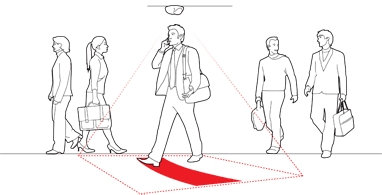
Retail Footfall Cameras are specialized counting devices deployed at store entrances, aisles, or zones that detect and count people as they move through a space. Unlike basic infrared door counters or manual clickers, modern Retail Footfall Cameras use optical, stereo, thermal, or video-analytics techniques to provide accurate counts as well as rich behavioral metrics such as zone dwell time, direction of movement, queue length, and heatmaps of high-traffic areas.
Key distinctions:
- Basic counter: counts pulses (e.g., infrared beam) — limited accuracy and features.
- Retail Footfall Cameras: uses image/video analytics to count people with higher accuracy and richer metrics.
- People-analytics camera: adds advanced features like occupancy management, demographic estimation (age/gender approximations), and staff vs. shopper differentiation.
2. How do Retail Footfall Cameras Work?
There are several technical approaches. Many retailers choose cameras because they balance accuracy with flexibility.
- 2D Video Analytics (Single IP Camera)
- Uses a single ceiling-mounted camera and software that analyzes frames to detect and count people crossing virtual lines or entering zones.
- Good for entrances and constrained passageways.
- Stereo/3D Cameras
- Two lenses (stereo) or time-of-flight sensors create depth maps, enabling better separation of overlapping people and improved accuracy in crowded entrances.
- Better robustness to shadows and lighting changes.
- Thermal/Infrared Cameras
- Detect heat signatures, useful in low light and privacy-sensitive installations (since they don’t capture facial detail).
- Often used for occupancy and social-distancing monitoring.
- LiDAR / Time-of-Flight Sensors
- Use distance measurements to create accurate counting with minimal privacy concerns.
- Wi-Fi / Bluetooth Device Sensing (complementary)
- Detects mobile device probe requests to estimate dwell times and repeat visits. Less accurate for raw counts but useful for behavioral analytics.
- Edge vs Cloud Processing
- Edge: analytics run on the camera or on a local appliance — reduces bandwidth and improves privacy.
- Cloud: camera streams to cloud analytics — easier central management and historical analytics.
- AI / Deep Learning Enhancements
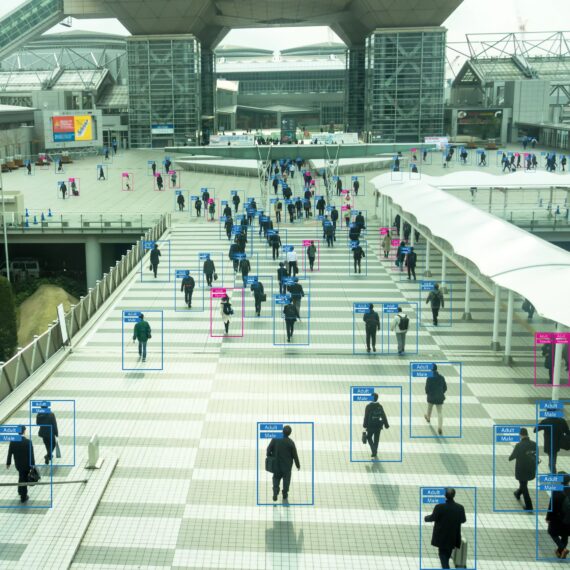
- Modern systems use AI models to better separate staff from visitors, ignore trolleys or strollers, and improve accuracy in crowded scenes.
Core Benefits of Retail Footfall Cameras
Retailers today operate in a competitive environment where customer behavior, store performance, and operational efficiency must all align for success. Retail Footfall Cameras are not just technological tools — they are strategic assets that transform raw visitor movements into actionable insights. From accurate counting to performance optimization, the benefits of Retail Footfall Cameras extend across every department — operations, marketing, sales, and management.
Below are the key benefits of adopting a Retail Footfall Cameras system for your business:
1. Accurate Visitor Counts
Accuracy is the foundation of all retail analytics. Retail Footfall Cameras provide precise, real-time data on how many people enter and exit your store — broken down by hour, day, week, or month.
With advanced AI-based video analytics, these systems can distinguish between adults, children, staff members, and groups to ensure reliability even in high-traffic environments such as shopping malls or supermarkets.
Accurate visitor data becomes the basis for:
- Reliable performance reports.
- Year-over-year trend analysis.
- Sales forecasting and budgeting.
- Strategic decision-making at both store and corporate levels.
For retailers in Qatar’s growing retail landscape — where shopping malls and lifestyle centers attract diverse customer groups — accurate visitor counts help understand changing demographics and shopping patterns.
2. Conversion Rate Calculation
Knowing how many customers entered the store is only half the story. The real value lies in knowing how many actually made a purchase.
When Retail Footfall Cameras data is integrated with your Point-of-Sale (POS) system, retailers can calculate the conversion rate using the simple formula:
Conversion Rate = (Number of Transactions ÷ Number of Visitors) × 100
This metric gives deep insights into store performance.
For example:
- A store with 1,000 visitors and 100 sales has a 10% conversion rate.
- Another store with the same sales but 2,000 visitors has only 5% — indicating untapped sales potential.
By comparing conversion rates across different outlets, retailers can identify best-performing stores, optimize staff training, and improve merchandising strategies to increase sales efficiency.
In a market like Qatar, where premium malls compete for brand differentiation, understanding and improving conversion rates is a key advantage.
3. Optimized Staffing & Roster Planning
Overstaffing during quiet periods wastes resources; understaffing during peak times hurts sales and customer experience. Retail Footfall Cameras solve this by providing hourly visitor data trends.
Store managers can align staffing schedules to match actual foot traffic:
- Deploy more staff during lunch or evening peaks.
- Schedule cleaning or restocking during low-traffic hours.
- Ensure sufficient coverage during weekends or promotions.
This data-driven roster planning improves efficiency, reduces unnecessary labor costs, and enhances customer satisfaction by ensuring staff availability when needed most.
Retail chains in Qatar, especially those in busy areas such as Doha Festival City or Villaggio Mall, benefit significantly from such optimization.
4. Store Layout & Merchandising Optimization
Where do shoppers go first? Which aisles attract the most attention? Which zones are ignored?
Retail Footfall Cameras equipped with heatmap analytics and zone tracking reveal exactly how shoppers move and behave within your store.
These insights allow you to:
- Position high-margin products in high-traffic areas.
- Optimize store layouts for better navigation and engagement.
- Design more effective promotional zones and product displays.
- Reduce congestion and improve flow for a smoother customer journey.
Retailers can test new layouts and measure the impact instantly using before-and-after heatmaps. In Qatar’s competitive retail spaces, where visual merchandising plays a vital role, this data helps retailers stay agile and innovative.
5. Marketing Effectiveness & Campaign Attribution
How do you know if your marketing campaigns are actually bringing customers through the door?
Retail Footfall Cameras provide measurable proof.
When you run a sale, social media campaign, or in-store event, you can track visitor traffic before, during, and after the campaign to measure its impact.
Benefits include:
- Clear ROI tracking for each campaign.
- Comparison between online promotions and physical store visits.
- Better budget allocation across advertising channels.
- Data-driven justification for future campaigns.
For instance, if a Qatar-based retailer runs a National Day sale, the system can show how visitor counts increased during the event and which hours saw the most engagement — allowing for more precise campaign planning in the future.
6. Queue Management & Improved Customer Experience (CX)
Long queues can frustrate shoppers and lead to lost sales. Retail Footfall Cameras equipped with queue detection and real-time alerts help retailers monitor service counters and checkout lines.
When the queue length exceeds a certain threshold, the system automatically alerts staff to open additional counters or assist customers.
The result:
- Reduced waiting times.
- Improved customer satisfaction.
- Higher retention and loyalty.
This is especially valuable in supermarkets, food courts, and electronics stores during weekends or holiday seasons when customer volume surges.
In Qatar’s retail sector, where customer service excellence is a key differentiator, implementing smart queue management powered by footfall cameras enhances the brand image and overall shopping experience.
7. Benchmarking Across Stores & Formats
Retail groups often operate multiple branches with different sizes and formats. Retail Footfall Cameras standardize measurement across all stores, enabling performance benchmarking.
Headquarters can compare:
- Traffic trends by location.
- Conversion rates by store type (mall, high street, airport).
- Staffing efficiency ratios.
- Campaign impact across multiple branches.
With this visibility, management can identify underperforming outlets, replicate the success of top performers, and plan better resource distribution.
For retailers in Qatar expanding into new malls or suburban developments, benchmarking ensures consistent performance standards across all locations.
8.Safety, Capacity & Compliance
Beyond business analytics, Retail Footfall Cameras contribute to safety and compliance.
Real-time occupancy monitoring helps ensure that your store or facility never exceeds legal or safety capacity limits.
Applications include:
- Emergency Evacuation: Quickly identify how many people are inside during an incident.
- Health & Safety Regulations: Monitor crowd density in compliance with local guidelines.
- Event Management: Manage capacity during special sales, celebrity visits, or public events.
During the pandemic era, many retail facilities adopted these systems to ensure safe distancing and compliance with government restrictions — and they continue to use them for operational safety.
For retailers in Qatar’s large shopping centers, such as Mall of Qatar or Doha Festival City, this feature is particularly valuable during peak tourist and holiday seasons.
9. Loss Prevention & Operational Insights
Retail Footfall Cameras analytics can reveal anomalies that indicate potential issues.
For instance:
- Sudden drops in visitor traffic may point to a malfunctioning entrance, signage issue, or competing event nearby.
- Comparing footfall with sales data may reveal possible shrinkage (theft) or poor staff performance.
- Correlating traffic data with CCTV and POS timestamps can help identify suspicious patterns.
Moreover, analyzing movement data helps security teams allocate staff strategically to high-risk areas.
10. Data-Driven Lease & Opening Hours Decisions
Every retailer faces decisions about store leasing, rent renewal, and opening hours. Retail Footfall Cameras data provides factual evidence for these discussions.
Examples:
- Lease Justification: If your store contributes significant foot traffic to a mall, you can use the data to negotiate better lease terms.
- Operating Hours: By analyzing hourly visitor trends, you can determine the most profitable hours to stay open and reduce unproductive late-night shifts.
- Expansion Planning: Identify locations with the highest visitor potential before opening new branches.
In a market like Qatar — where retail spaces vary from luxury malls to community shopping centers — these insights are vital for optimizing cost and profitability.
Key Features to Expect from Modern Retail Footfall Cameras
Retail Footfall Cameras have evolved far beyond simple people-counting devices. Today’s systems combine artificial intelligence, computer vision, and analytics to deliver real-time business intelligence for retailers. Whether installed in a single store or across multiple branches, these advanced systems provide deep insights into customer behavior, operational efficiency, and marketing performance.
Below are the essential features and technologies you should expect from a modern Retail Footfall Cameras system.
1. High Counting Accuracy (Up to 98–99%)
Accuracy is the most critical feature of any people counting system. Modern Retail Footfall Cameras use 3D stereo vision, AI algorithms, and deep learning models to achieve near-perfect accuracy even during peak hours.
They can:
- Distinguish between adults, children, and groups.
- Avoid double counting when people move together.
- Filter out non-human objects such as carts, trolleys, or mannequins.
- Maintain accuracy despite shadows, reflections, or lighting changes.
This level of precision ensures that every business decision — from staffing to promotions — is based on reliable and consistent data.
2. Directional Counting (In/Out Detection)
Directional counting allows the system to differentiate between incoming and outgoing visitors.
This is especially useful for:
- Calculating real-time occupancy levels.
- Tracking entry vs. exit ratios for better flow management.
- Measuring retention — how many customers leave quickly versus those who stay and shop.
In multi-entrance stores or large malls in Qatar, this feature helps retailers accurately measure how visitors move between zones and which entrances generate the most traffic.
3. Real-Time Occupancy Monitoring
Modern retail environments — especially large malls and department stores — need to monitor live occupancy for safety and compliance.
Retail Footfall Cameras continuously update the number of people currently inside the store, allowing management to:
- Set automatic alerts when occupancy limits are reached.
- Display live occupancy data on digital screens for transparency.
- Support safety measures during special events or peak seasons.
This feature was originally popularized during pandemic capacity restrictions, but it remains valuable today for safety and operational control.
4. Multi-Lane and Wide Entrance Support
Many retail entrances are wide, open spaces with heavy traffic. Advanced systems support multi-camera stitching or wide-angle stereo vision, ensuring accurate counting even across large entrances or glass doors.
Features include:
- Overlapping detection zones for wide coverage.
- Edge-based synchronization between multiple cameras.
- Scalability to handle multiple floors or building zones.
This is especially useful in Qatar’s large-format stores, supermarkets, and mall anchor tenants where thousands of visitors pass through daily.
5. Zone Counting and Heatmap Analytics
Beyond entry counts, Retail Footfall Cameras can track how visitors move inside the store. Heatmaps visualize areas of high and low traffic, while zone analytics measure time spent in specific departments.
Benefits include:
- Identify popular product areas and under-performing zones.
- Optimize product placement and store layout.
- Evaluate the success of in-store promotions and digital signage.
For example, a fashion retailer in Doha can see whether customers spend more time in men’s or women’s sections and rearrange displays to balance engagement.
6. Queue Detection and Real-Time Alerts
Long queues discourage purchases and harm customer satisfaction. Modern Retail Footfall Cameras include queue management functionality, automatically detecting queue lengths and waiting times.
When the system senses that a queue is building up beyond a predefined threshold, it can:
- Send instant alerts to store managers.
- Trigger automated messages on digital signage (e.g., “Counter 3 now open”).
- Help allocate staff efficiently.
This proactive approach enhances customer experience (CX) and reduces lost sales during busy periods — especially valuable for supermarkets, cafés, and service counters in Qatar’s high-traffic malls.
7. Integration with POS, ERP, and BI Systems
Retail Footfall Cameras data becomes far more powerful when integrated with your existing software ecosystem.
Leading systems offer API and SDK integration with:
- POS (Point of Sale) — to calculate conversion rates.
- ERP Systems — for inventory planning and store performance analysis.
- CRM Tools — to correlate visitor data with customer loyalty metrics.
- Business Intelligence Dashboards — such as Power BI or Tableau for visualization.
Integration enables data-driven decision making and helps unify offline and online performance tracking for omnichannel retailers.
8. Edge Processing and AI-Driven Analytics
Modern Retail Footfall Cameras are designed with edge processing capabilities. This means analytics happen directly on the camera or a local device — not in the cloud — ensuring:
- Faster real-time results.
- Reduced bandwidth consumption.
- Enhanced data privacy.
AI algorithms on the edge can filter out false positives, differentiate staff from shoppers, and even estimate age or gender (where legally compliant).
This makes the system smart, efficient, and compliant with Qatar’s data protection norms.
9. Privacy-Friendly Design (No Facial Recognition)
Privacy compliance is a growing concern for retailers. Today’s footfall cameras use anonymous detection methods that do not store or transmit any personally identifiable information (PII).
Features include:
- Face blurring or silhouette detection only.
- Thermal imaging options for privacy-sensitive environments.
- Local data aggregation instead of raw video storage.
This ensures full compliance with privacy guidelines and maintains customer trust — a vital factor in Qatar’s regulated business environment.
10. Cloud Dashboard and Centralized Management
For multi-branch retailers, managing data from multiple stores can be challenging. Retail Footfall Cameras now include cloud-based dashboards that provide centralized visibility and reporting.
Key capabilities:
- Consolidate data from all branches into a single platform.
- Monitor live traffic across all stores.
- Generate automated daily, weekly, and monthly reports.
- Access insights remotely via web or mobile app.
This helps regional managers and executives in Qatar oversee performance trends across all retail locations — from malls in Doha to outlets in Al Wakrah or Lusail.
11. Historical Reporting and Predictive Analytics
Advanced reporting modules go beyond simple graphs. They allow:
- Comparison between time periods (day-on-day, week-on-week).
- Forecasting of future traffic using AI-based predictive models.
- Identification of seasonal trends and anomalies.
Predictive analytics help retailers prepare for future events, optimize inventory, and schedule staff more effectively based on expected visitor patterns.
12. Integration with Digital Signage and IoT Systems
Retail Footfall Cameras can be connected with other smart systems in a store — such as digital signage, queue displays, HVAC, or lighting control.
For example:
- Display “Live Store Occupancy” messages on digital screens.
- Adjust lighting or music intensity based on crowd density.
- Trigger targeted advertising content when foot traffic increases.
This turns a traditional store into a smart retail environment, improving engagement and operational efficiency simultaneously.
13. Robustness Against Environmental Conditions
Retail entrances often have variable lighting, reflective floors, or glass doors that can confuse traditional sensors.
High-end Retail Footfall Cameras are designed for robust performance under such conditions:
- Wide Dynamic Range (WDR) for bright or dim lighting.
- Anti-glare optics for glass storefronts.
- Weatherproof casings (IP-rated) for semi-outdoor entrances.
This durability ensures consistent performance and low maintenance costs — ideal for Qatar’s hot climate and outdoor retail zones.
14. Power over Ethernet (PoE) Support
Retail Footfall Cameras with PoE (Power over Ethernet) simplify installation by using a single cable for both power and data.
This reduces cabling costs, simplifies maintenance, and ensures cleaner installations — particularly important in premium retail interiors or malls.
15. Local Data Storage and Backup
In case of network interruptions, smart Retail Footfall Cameras feature local memory or SD card backup to store data temporarily. Once connectivity is restored, the data automatically syncs with the server — preventing data loss and maintaining reporting continuity.
16. Customizable Dashboards and Alerts
Modern systems offer intuitive dashboards that can be customized based on the user’s role.
For instance:
- Store Managers can view real-time occupancy and queue alerts.
- Marketing Teams can analyze campaign impact.
- Executives can access consolidated reports for multiple branches.
Alerts can be sent via email, SMS, or push notifications, ensuring managers act immediately when unusual patterns or thresholds are detected.
17. Staff Exclusion and Employee Tagging
To prevent inflated counts, advanced systems can exclude staff movement from visitor counts using badges, AI recognition, or defined zones.
This ensures the accuracy of customer-only data, leading to more meaningful business metrics.

Typical Retail Use Cases for Footfall Cameras
One of the greatest advantages of Retail Footfall Cameras is their flexibility. These intelligent systems can be adapted to a wide variety of retail environments — from luxury boutiques and hypermarkets to shopping malls and pop-up stores.
Whether the goal is to measure visitor numbers, optimize store layouts, or improve customer service, footfall analytics offers valuable insights that support smarter decision-making.
1. Store Entrance Counting (Standard Application)
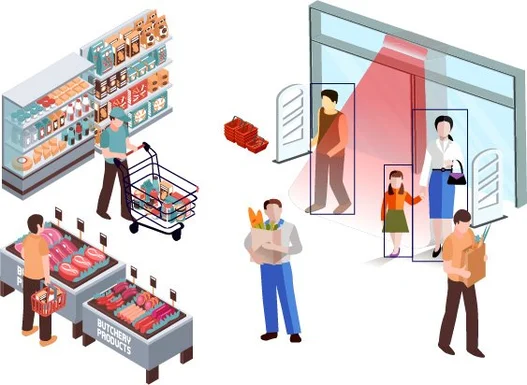
The most widely used and fundamental application of Retail Footfall Cameras is entrance counting.
A single or stereo camera is typically installed above each main entrance and exit point to accurately record every visitor entering or leaving the store.
This provides a reliable baseline metric for:
- Measuring total traffic.
- Identifying busy and quiet periods.
- Calculating conversion rates when integrated with POS systems.
- Monitoring occupancy in real-time.
Entrance counting is especially vital for malls and shopping centers in Qatar, where customer flow can vary dramatically during weekends, public holidays, and major events.
For example, during Ramadan or Qatar National Day promotions, retailers can use entrance data to track increases in foot traffic and evaluate campaign success.
2. Dwell Time & Zone Heatmaps (Merchandising Optimization)
Beyond counting entries, modern Retail Footfall Cameras generate heatmaps that visualize customer movement within the store.
By monitoring dwell time in specific areas, retailers can identify:
- Which displays or shelves attract the most attention.
- Which zones are underperforming.
- How shoppers navigate through different product sections.
These insights are extremely useful for visual merchandising teams and store planners.
For example:
- If customers consistently linger around promotional zones, the layout can be optimized to encourage further exploration.
- If certain areas receive low engagement, the product mix or signage can be adjusted.
In Qatar’s high-end retail sector — especially in fashion and electronics — understanding how customers interact with displays helps brands fine-tune layouts for maximum engagement and revenue.
3. Queue & Till Management (Service Optimization)
Retail Footfall Cameras can also play a crucial role in queue management and checkout optimization.
By analyzing the number of customers in specific areas, such as cashier queues or service counters, the system can automatically detect when lines are forming or growing too long.
When queue thresholds are exceeded, real-time alerts can be sent to supervisors or staff through displays or mobile notifications. This allows immediate action — such as opening additional tills or redirecting customers to other counters.
The results include:
- Reduced waiting times.
- Increased throughput at checkout.
- Improved customer satisfaction.
- Fewer abandoned baskets.
For supermarkets, electronics retailers, and fast-fashion outlets in Qatar, where long queues during peak hours can deter shoppers, implementing such smart systems is a powerful way to maintain customer loyalty and operational efficiency.
4. Pop-Up or Promotional Event Measurement
Retail Footfall Cameras are also ideal for temporary setups, such as pop-up stores, in-store activations, and promotional booths.
Since these systems can be easily installed and removed, they enable retailers to:
- Measure visitor engagement during short-term campaigns.
- Compare traffic before, during, and after marketing events.
- Evaluate ROI for brand activations or sponsorships.
For example, if a beauty brand in Doha Festival City launches a weekend pop-up stand, Retail Footfall Cameras data can confirm how many people visited and interacted with the booth — providing tangible metrics to assess marketing performance.
Such insights help marketing teams justify spend, plan future events more effectively, and optimize placement for maximum exposure.
5. Mall or Multi-Tenant Analytics
Shopping mall management and property owners also benefit from Retail Footfall Cameras systems. By aggregating data from multiple zones, mall-wide analytics can be achieved.
Benefits include:
- Understanding visitor flow between different tenants.
- Tracking peak hours in food courts, entertainment zones, or entrances.
- Measuring common area traffic.
- Providing performance reports for individual tenants or zones.
This data helps mall operators attract and retain tenants, justify rent pricing, and plan promotional events more effectively.
In Qatar, where malls such as Villaggio Mall, Place Vendôme, and Mall of Qatar are key retail destinations, mall-wide footfall analytics can help property managers provide detailed reports that support both tenants and investors.
6. High-Traffic Entryways & Wide Frontages
Large retail stores often feature wide entrances or open storefronts — such as hypermarkets, furniture outlets, and electronics showrooms.
In these cases, a single camera may not cover the entire entrance area accurately.
To maintain precision, stereo cameras or multi-sensor setups are used to create a seamless coverage field. These advanced systems ensure:
- Accurate counting across wide zones.
- Elimination of double counting or missed detections.
- Reliable analytics even under fluctuating lighting or crowded conditions.
Retailers in Qatar’s large-format stores (e.g., Carrefour, Lulu, or IKEA) benefit from this capability to handle thousands of visitors daily while maintaining accurate and real-time traffic data.
7. Store Performance Benchmarking
Retail Footfall Cameras data is essential for comparing performance across multiple outlets.
Retail chains can analyze metrics such as:
- Visitor count per square meter.
- Conversion rate per store.
- Average dwell time.
- Peak-hour performance.
These benchmarks allow management to:
- Identify top-performing branches.
- Replicate successful practices across locations.
- Detect underperforming outlets and investigate reasons.
- Adjust marketing and staffing strategies accordingly.
For example, if one store consistently attracts higher traffic but lower conversions than another, the issue might be with product assortment, pricing, or service — not just location.
In Qatar’s expanding retail landscape, where brands often operate multiple branches across malls and high streets, benchmarking ensures consistency in performance and customer experience.
Axle Systems — Your Local Supplier & Partner in Qatar
Axle Systems specialises in supplying, installing, and supporting retail technology solutions across Qatar — including Retail Footfall Cameras, people counting sensors, and people analytics systems. With deep experience deploying solutions for shopping malls, retail chains, supermarkets, and pop-up stores, Axle Systems provides end-to-end services:
Services offered
- Site survey and technical consultation to select the right sensor type (2D/3D/thermal).
- Supply of best-of-breed Retail Footfall Cameras and sensors, from proven manufacturers.
- Installation, mounting, cable routing (PoE), and on-site calibration.
- Integration with POS, CRM, workforce and BI systems through APIs and connectors.
- Custom dashboard creation and recurring reporting tailored to marketing and store ops.
- Maintenance contracts, firmware updates, and SLA-driven support.
- Training for store managers and corporate teams on interpreting analytics and acting on insights.
Why choose Axle Systems
- Local presence and bilingual support (Arabic/English).
- Expertise in retail workflows and Qatar market specifics.
- Proven track record across multiple retail categories (malls, supermarkets, fashion, convenience stores)
- Flexible pricing and scalable deployments for single stores to nationwide rollouts.
- Commitment to privacy and compliance best practices.
Contact Axle Systems
- Phone: +974 44682391 / +974 77443731
- Email: info@axlesys.com
- Website: www.axlesys.com
- Office: Al Khalidiya Street, Najma, Doha, Qatar
Conclusion
In today’s fast-paced and competitive retail landscape, understanding customer behavior is no longer optional — it is essential. Retail Footfall Cameras provide retailers with a sophisticated, data-driven solution to track visitor traffic, analyze shopper behavior, optimize store operations, and ultimately boost sales and customer satisfaction.
From accurate visitor counting at store entrances to zone heatmaps, queue detection, and occupancy management, these intelligent systems empower retailers to make informed decisions that improve efficiency, reduce costs, and enhance the shopping experience. By integrating footfall data with POS, marketing campaigns, and workforce management tools, retailers gain a holistic view of their business performance — enabling smarter staffing, merchandising, and marketing strategies.
In multi-store environments or large shopping malls, Retail Footfall Cameras also provide benchmarking insights, allowing management to identify best practices, replicate successful strategies, and monitor tenant or store performance effectively. For temporary events, pop-up stores, or promotional campaigns, Retail Footfall Cameras analytics provides measurable data to evaluate ROI and refine marketing approaches.
In Qatar’s growing retail sector, where shopping malls, hypermarkets, boutiques, and luxury stores compete for attention, leveraging Retail Footfall Cameras is critical. They offer real-time insights, safety compliance, loss prevention, and omnichannel integration — all within a privacy-friendly and scalable framework.